Everyone feels like they need to be creating content right now.
So you start asking the practical questions: where to post it, how often, which platform, what format works best? All fair questions.
But answer them fast enough, for long enough, and you end up on a content treadmill, publishing because you feel obliged to, not because any of it is making a measurable difference to your business.
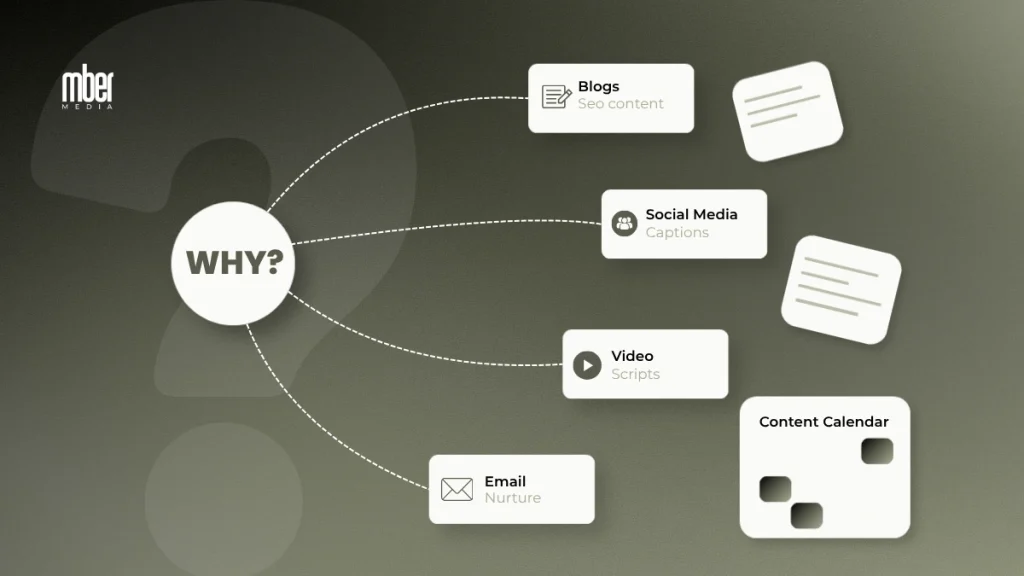
Somewhere in that mad scramble of where and how, the question that we think matters gets lost: why? Why this piece, why should my audience care, why now?
The ‘why’ questions are harder to ignore than they used to be. Roughly three in four new web pages published today contain AI-generated content, according to a recent Ahrefs study.
Producing content has never been easier or more common, which means simply adding to the pile is no longer a strategy. More ‘noise’ (as AI likes to call it) is not the answer, no matter how consistently you make it.
This guide is about pausing the treadmill long enough to ask why you’re creating content in the first place, what outcome each piece is actually meant to deliver, so the where and how finally start making sense.
If you want to share messages worth remembering, start with the Mber Audit.
TL;DR
- Content marketing hasn’t stopped working, but ‘publish more, more often’ has stopped being enough
- AI has made content volume worthless: 74% of new web pages now contain AI-generated content
- Search increasingly ends before anyone reaches your site: 68% of Google searches end without a click, over 80% when an AI Overview appears
- Search has splintered across platforms, Gen Z now searches Instagram, TikTok, and Google in near-equal measure
- Match content type to outcome, not the other way around
- Get messaging foundations and consistent profiles sorted before creating anything new
- Planning matters more than creating, and should always involve a human
- Results compound over 3-6 months, not overnight
Content marketing has changed
I’ve been in content marketing for 9 years now, and things have changed significantly over this time. I put it down to three main reasons. Here’s a quick summary of each and the stats I found to support them.
AI has made content volume worthless
Producing content at scale used to take time, which meant it was at least a little scarce. That scarcity is completely gone. An Ahrefs study of roughly 900,000 web pages published in April 2025 found that 74.2% contained detectable AI-generated content, and 97% of content marketers say they plan to use AI somewhere in their content process this year. Everyone can produce a lot of content quickly now. Which means a lot, quickly, is no longer a differentiator, it’s the baseline.
Search increasingly ends before anyone reaches your site
SEO, or search engine optimisation, helps your page rank in a list of results. GEO, or generative engine optimisation, helps your content get retrieved and cited inside AI-generated answers. SEO competes for position. GEO competes for inclusion, and one well-built post can win both.
Search itself has splintered across platforms
Google was once the whole picture. It isn’t anymore. Recent research shows Gen Z now searching Instagram, TikTok, and Google in almost equal measure: 67% use Instagram, 62% use TikTok, and 61% use Google, depending on what they’re looking for and at what stage of the decision.
A local recommendation might start on TikTok. A product comparison might happen on Instagram. A B2B research task still tends to happen on Google or LinkedIn. The audience hasn’t disappeared, it’s just spread out and become more selective about what gets their attention.
Put these three shifts together and the maths changes. More content is being made than ever, it’s less likely to be clicked on when it does appear, and the places people are searching from have multiplied. Publishing more, into more places, isn’t a strategy that scales its way out of this. It’s the treadmill from a moment ago, just running faster.

Understanding your content marketing options in 2026
If more content isn’t the answer, the right content is. That starts with knowing what each type of content is actually built to do, so you’re not asking a blog post to do a video’s job, or expecting one social post to carry the weight of a case study.
Content marketing spans a handful of core formats. Each has a natural home in the customer journey, a specific purpose, and a different measure of success. The table below sets that out at a glance, so you can see at a moment where a piece of content should sit and what you should expect it to deliver.
| Content type | What it is | Funnel stage | Purpose | Desired outcome |
|---|---|---|---|---|
|
Blog and website content |
Articles, guides, and service pages that answer questions your audience is already asking |
Awareness / Consideration |
Build search and AI visibility, establish expertise |
Organic traffic, AI citation, time on page |
|
Social media content |
Posts, reels, and stories built for the platforms your audience actually uses |
Awareness
|
Build familiarity, reach new audiences
|
Reach, engagement, follower growth
|
|
Video content |
Explainers, demonstrations, and short-form video
|
Awareness / Consideration
|
Explain, demonstrate, humanise the brand
|
Watch time, shares, click-through to site
|
|
Email newsletters |
Direct, owned communication with people who have already opted in
|
Consideration / Retention
|
Nurture leads, retain existing customers
|
Open rate, click rate, repeat engagement
|
|
Case studies and testimonials |
Evidence-based content showing real client results
|
Decision
|
Provide proof, reduce risk for the buyer
|
Sales enablement use, conversion rate
|
|
Whitepapers, guides, and lead magnets |
Longer-form, often gated content that trades depth for contact details
|
Consideration
|
Capture engaged, qualified leads
|
Lead volume, lead quality
|
|
Podcasts and audio |
Conversational, long-form content
|
Awareness / Consideration
|
Build authority and familiarity over time
|
Listenership, brand recall, referrals
|
The table is deliberately a starting filter, not a rulebook. If you’re not sure what to create next, work backwards from it: decide which funnel stage needs the most attention right now, then pick the content type actually built for that job.
A business struggling to be found needs blog and social content, not another case study. A business with plenty of traffic but few conversions probably needs the opposite.
This is also where the ‘why’ question from earlier pays off. Once you know the outcome you’re chasing, choosing the right format stops being a guess.
‘Just because you can now create content for any platform in a click doesn’t mean you should. Every business has a different level of time, need and budget when it comes to content. It’s about figuring out a business’s ‘why’ behind content creation and then making a plan that gets the results they need.

Bec Mauger
Owner and Lead Strategist/Copywriter

Pause: What’s your content ‘why’?
If someone guaranteed that every dollar you put into content would come back as something specific, what would you actually want that something to be? More enquiries a month? A shorter sales cycle because prospects arrive already convinced? Better talent applying because your brand looks like a place worth working? Name it now. And if you can’t, you’re not investing in content, you’re spending on it, and those are very different things.
Now you've got your why. Here's how to run content marketing that actually works
A client came to us earlier in the year with a folder of beautiful content. Professional photography, polished copy, a consistent posting schedule for months. On paper, it looked like content marketing done right. In practice, it wasn’t generating a single enquiry!
The problem wasn’t the content itself. It was the order everything had happened in. Nobody had settled what the business actually stood for before the content started. Nobody had checked whether the website and social profiles were even saying the same thing. And nobody had planned each piece against a purpose, so the content calendar had filled up with things that were easy to make, not things that were worth making.
Getting the ‘why’ right, as we covered earlier, is the start. What comes next is running that why through a system, so the effort you put in actually turns into something. Here’s the order we use.
1. Get your messaging foundations right
This step is non-negotiable. Before a single piece of content gets made, you need absolute clarity on what your business does, who it’s for, and why anyone should choose you over the alternative. Skip this and everything downstream is a guess wearing a strategy’s clothes.
At Mber, we build this through the Mber Profile, a structured foundation covering your mission, your brand, and the results you deliver. It’s the reference point every piece of content gets checked against, so nothing goes out that’s off message, even if it’s beautifully written.
2. Optimise your website and all your profiles
Don’t put the cart before the horse. There’s little point investing in new content if the places people already find you are inconsistent, outdated, or quietly contradicting each other.
Before you create anything new, take stock of where your customers actually encounter your business:
- Your website, especially the pages people land on first
- Your Google Business Profile
- Your social channels, including the ‘About’ sections nobody reviews after setup
- The details people forget: email signatures, team bios, directory listings
Ask one honest question of each: is this telling the same story as everything else? If the answer is no, fix that first. New content only compounds a message that’s already aligned, it can’t fix one that isn’t.
3. Plan
Here’s something that surprises a lot of business owners: creating content is now the easy part. AI has made drafting fast. What’s hard, and what actually determines whether content works, is the planning behind it.
Good planning means:
- Knowing your ICP. Not ‘everyone who might buy from us,’ but a specific person, with a specific problem, at a specific stage of deciding.
- Checking every idea against your Mber Profile. On brand in theory isn’t the same as genuinely on message.
- Being honest about purpose before you commit time. If you can’t say what a piece of content is meant to achieve, it’s not ready to be made yet.
This is also the one step we never hand over to AI. Planning is judgement: knowing your market, your client, and what’s worth saying right now. That’s a human job, always.
4. Create
This is where craft earns its keep. Good content isn’t just the right words or a decent graphic. It’s something memorable, something that genuinely holds attention, and something pitched correctly for its stage of the funnel, an awareness piece doesn’t need to close the sale, and a case study shouldn’t be trying to introduce your brand from scratch.
A few things worth investing in properly:
- Branding and visuals that look considered, not templated
- Original research or real client detail behind every claim
- A healthy scepticism of AI-generated drafts. AI is a genuinely useful starting point, but it will confidently invent facts, quotes, and statistics that don’t exist. Check everything before it goes anywhere near your audience.
5. Be consistent
One brilliant piece of content, surrounded by months of silence, doesn’t build trust. It builds a memory that fades. Consistency is what turns individual pieces into a body of work your audience starts to recognise and rely on.
6. Don't expect it all to happen overnight
Content marketing compounds, it doesn’t spike. Most businesses see meaningful traffic or lead growth from three to six months in, and visibility in AI-generated answers tends to take longer again. Set that expectation from day one, so you’re judging month one fairly, as the start of something, not a result in itself.

Questions I often get asked about content marketing
Do I need to be on every platform?
No. Trying to show up everywhere is how content quality drops and consistency dies. Pick the one or two platforms your actual customers use, and do those properly. A strong, consistent presence on two channels beats a thin, patchy one on six.
Is blogging still worth it?
Yes. Even with search behaviour shifting, blog content remains one of the clearest ways to build authority, answer real customer questions, and give AI systems something substantial to draw from when they’re summarising your business. What’s changed isn’t whether to blog, it’s how thin or generic a blog post can afford to be.
How do I make sure my content marketing is GEO friendly?
GEO, generative engine optimisation, means writing so AI tools can easily extract, understand, and cite what you’re saying. That means clear structure, direct answers to specific questions, credible sourcing, and genuine expertise on the page, not just keywords stuffed in to chase rankings. If a human can skim your content and immediately understand your point, an AI system generally can too.
I feel like I'm doing everything right but not getting a return. What's wrong?
It depends on where the gap is. No traffic usually points to a visibility problem: your content isn’t being found by search, AI, or social. Traffic that isn’t converting usually points to a messaging problem: people are finding you, but what you’re saying isn’t landing or isn’t clear enough to act on. Diagnosing which one you have matters more than making more content. Reach out, we can help you fix both.
Do I even need a website if people don't visit it directly anymore?
Yes. Your website is still where you control the narrative, including the narrative AI tools tell about your business. LLMs and search engines pull from your site to describe who you are, what you do, and why you’re credible. Without a strong, accurate website, you’re leaving that story to whatever fragments happen to be online about you, which is rarely the full picture.