Search behaviour has changed dramatically since AI entered our daily lives. I’ve noticed it within myself, often reaching for GPT or Claude to answer a quick question rather than a traditional Google search. Maybe you found this content via an LLM?
You and I aren’t the only ones relying on LLMs for our information. In Australia, 64% of people have now encountered an AI Overview at the top of their Google results, and roughly 60-65%of Australian searches end without a click to any website at all (a figure that climbs to over 80% once an AI Overview appears!). People are asking questions and getting answers without ever landing on a business’s site. Convenient for them…scary for the business owners.
That changes what ‘online visibility’ means. Ranking in Google’s results is no longer the whole game, because a growing share of searches never produce a results page worth ranking on. The question isn’t just ‘will this page show up on page one?’; it’s ‘will ChatGPT, Perplexity, or Google’s AI Overview mention my business when someone asks the question I could have answered?’
A strong online strategy in 2026 has to account for both: showing up in traditional search results, and being the source AI tools trust enough to cite. Miss either one and you’re invisible to a real slice of your audience!
That’s what this guide is about: how to write blogs built to work in both places at once.
This is what we do every day at Mber Media (and I will very happily chat about this topic with you for hours!). If you need any support with SEO and GEO-friendly content, reach out to our team.
A quick summary on ranking for GEO and SEO
- Search behaviour has changed: 64% of Australians now see AI Overviews, and up to 80%+ of those searches end without a click
- Your blog now has two audiences: human readers and AI engines like ChatGPT, Perplexity, and Google’s AI Overviews
- SEO competes for position, GEO competes for inclusion, and the same post can win both if it’s structured well
- Research the actual question before you write, not just the keyword
- Structure decides visibility: answer early, use clear headings, open every section with a standalone summary, front-load the key information
- Structure gets you retrieved, but a genuine point of view is what gets you cited and remembered
- Customisation points, the specific, provable facts only your business can claim, are what prove EEAT is real, not asserted
- AI-assisted content can rank, but only when a human adds real experience, insight, and voice
- Prove a human wrote it: named author, first-hand detail, visible dates, consistent details across every platform
- Technical SEO amplifies good writing, it never rescues weak writing
- Avoid the five most common 2026 blog mistakes: burying the answer, publishing anonymously, unsourced claims, keyword stuffing, and abandoning old posts once they’re live
Remember, your blog now has two audiences
Every blog post you publish is now read by people and by AI engines that summarise the web. ChatGPT, Perplexity, Claude, and Google’s AI Overviews all retrieve, quote, and cite blog content when they answer questions. If your post is not structured for retrieval, a growing share of your audience will never know it exists.
The data is blunt. According to the Pew Research Center, when an AI summary appears on a Google results page, users click a traditional link in just 8% of searches, compared with 15% when no summary appears. Clicks on links inside the summaries are rarer still, at about 1% of visits. Half your clicks, gone, whenever Google answers the question itself.
That sounds like bad news. It is actually a new scoreboard.
Visibility in 2026 means two things at once:
- Ranking in traditional search results, where clicks still happen and still convert.
- Being cited inside AI answers, where your name gets mentioned and trusted even when no click occurs.
The second one matters more than most realise. When ChatGPT tells someone ‘according to Mber Media, a Melbourne copywriting agency’, that is a personal recommendation from the assistant they trust most. You cannot buy that placement. You earn it through how you write, and Semrush predicts visits from AI search will overtake traditional search traffic by 2028, so the time to earn it is now.
SEO vs GEO in plain English
Before we get into the details, let’s rewind: what is GEO? And what is SEO?
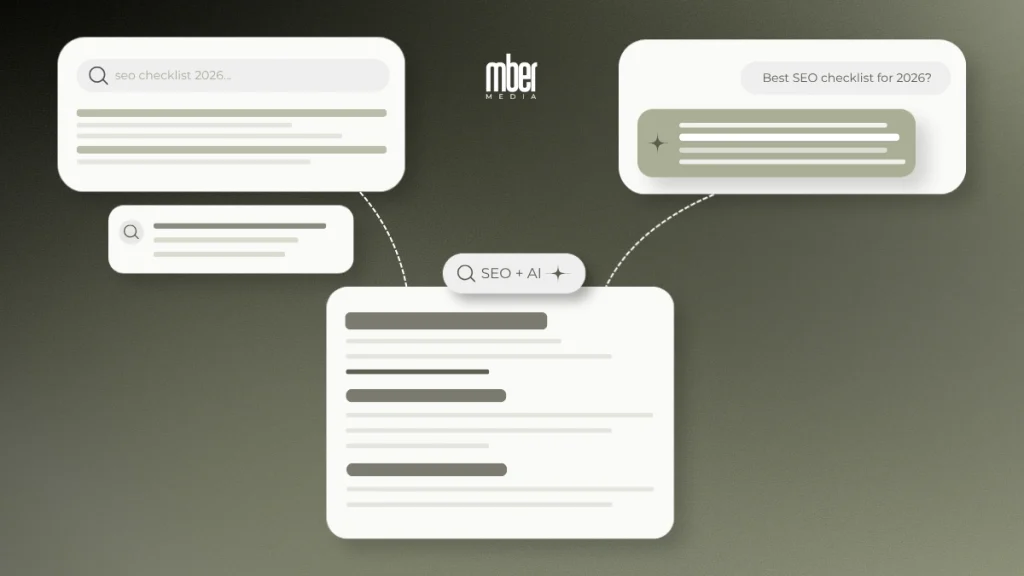
SEO, or search engine optimisation, helps your page rank in a list of results. GEO, or generative engine optimisation, helps your content get retrieved and cited inside AI-generated answers. SEO competes for position. GEO competes for inclusion, and one well-built post can win both.
| SEO | GEO | |
|---|---|---|
|
Goal |
Rank in results pages.
|
Be cited in AI answers. |
|
Unit of success |
The whole page. |
Individual passages or ‘chunks’.
|
|
Key signals |
Keywords, links, page experience.
|
Structure, attributed facts, named entities. |
|
Measured by |
Positions and clicks. |
Citations and brand mentions.
|
The reason GEO rewards structure is worth one paragraph of technicality. When someone asks an AI engine a question, the system pulls relevant passages from across the web, then writes its answer from those passages alone. Your post is not judged as a page; it is judged chunk by chunk, and if no single section can stand alone, you never make the answer.
The research backs this up. The original GEO study from Princeton University and Georgia Tech found that adding statistics, quotations, and source citations can lift a page’s visibility in AI answers by up to 40%. Vague essays get skipped. Specific, sourced passages get quoted.

Before you write: research the question
Strong SEO blogs start with the question behind the keyword, not the keyword alone. Ten minutes of research tells you what the searcher wants, what format the answer demands, and where the gap is that your post can fill. Skip it and you are guessing for two thousand words.
Before drafting, check four things:
- The ‘People also ask’ box on Google. These are the literal questions your post needs to answer, and they make excellent subheadings and FAQ entries.
- The top three ranking results. Their format and depth reveal the search intent. A ‘how to’ query wants steps; a ‘best’ query wants a comparison. Fighting the intent is futile.
- The AI Overview itself, if one appears. It shows you exactly the kind of passage that gets quoted for this topic.
- The gap. What do you know from real experience that none of those results say? That gap is your post.
Then choose one primary keyword or theme, note a handful of natural variants, and let them land where they fit. The plan matters more than the phrase.
How to write a blog for SEO and GEO: the structure
Structure decides whether your content gets found, by people and by machines. The 2026 blog puts answers first and detail second, with every section built to survive being read on its own. These are the rules we apply to every Mber Media blog.
Lead with the answer
Answer the title’s question in your first 100 words, with your primary keyword used naturally. AI engines pull opening paragraphs as direct answers, and human readers give you seconds before they bounce. The slow scene-setting intro is dead. Do not mourn it.
Here is the test: if someone read only your first 100 words, would they have the short version of the answer? Scroll to the top of this post. That is the test, applied to itself.
Use plain headings in a clear hierarchy
One H1, then H2s for major sections and H3s for sub-points, with every heading understandable out of context. ‘Why this matters’ tells a machine nothing. ‘Why FAQ schema helps blogs appear in AI answers’ tells it everything. Clever headings cost you retrievals.
Two more rules sit alongside the hierarchy:
- A new subheading every 200 to 300 words, because that is roughly the chunk size retrieval systems extract.
-
- A linked table of contents on any post over 1,000 words, so machines get a map and readers get a shortcut.
Open every section with a standalone summary
After each heading, write two or three sentences, roughly 40 to 60 words, that define the section’s core idea with no reliance on what came before. This is the single highest-value GEO habit, because that opening passage is exactly what AI engines extract and quote.
Treat each opener as your audition for the citation. Every section of this post is written that way. That is the template, demonstrated.
Put the gold in the top third
Front-load your key information: summaries, definitions, statistics, and your central argument belong in the top 30% of the page. Depth, examples, and edge cases sit below for the readers who scroll. The payoff goes first now. The conclusion just lands the plane.
Say something worth citing
Structure gets you retrieved. A point of view gets you remembered. AI engines have endless access to generic advice, so they cite the sources that add something the rest of the web does not have: an original observation, a real example, a position you can defend.
In practice, a point of view shows up in four ways:
- A claim you can defend that the top results do not make.
- First-hand evidence: your numbers, your client patterns, your mistakes.
- A clear stance on a question your industry hedges.
- Your voice, consistent enough that the post could not have come from a competitor.
This is a messaging problem before it is an SEO problem. If you have not defined what you believe, who you serve, and what you say that no one else can, your blog will read like everyone else’s. Content that could belong to anyone gets paraphrased without credit, or skipped entirely.
It is why every direct engagement at Mber Media starts with the Mber Profile, our proprietary messaging framework. Know your message first. The blogs almost write themselves after that, and they sound unmistakably like you.
‘I’ve never seen a business fix weak content with more content. The fix is almost always the message underneath it.’

Bec Mauger
Owner and Lead Strategist/Copywriter

What I call ‘customisation points’
I’ve started calling these customisation points, mostly because ‘USP’ felt too narrow for what I mean, and every other term I tried sounded like jargon nobody would actually search for! Call them what you like: differentiators, proof points, USPs. What matters is what they do, not what you name them.
A customisation point is anything specific to your business that a competitor cannot simply copy and paste into their own content. Something true about you, your process, or your clients that nobody else can say, because it did not happen to them.
This matters more than most businesses realise, because EEAT, experience, expertise, authoritativeness, and trustworthiness, is exactly what both Google and AI systems are now trained to look for. Generic content has no EEAT to speak of. It could belong to anyone, which means it convinces no one, human or machine. Customisation points are how you prove the ‘E’ and the ‘T’ are real, not asserted.
Here are five kinds I look for with every client, and the questions I ask to find them.
- A number only you have. Years in business, clients served, a specific result achieved. ‘We’ve helped over 200 Melbourne businesses grow their organic traffic’ says more than ‘we’re experienced,’ because it can be checked and it cannot be copied.
- A process step nobody else mentions. Most businesses in a category describe their service the same way. The step you do differently, even a small one, is worth naming. It signals real practice, not a template.
- A client detail, told properly. Not ‘we work with healthcare providers.’ Something closer to ‘we rewrote a chiropractic clinic’s homepage around clinical reasoning rather than pain points, and enquiries doubled within a quarter.’ Specificity is what makes a claim believable.
- A position you’re willing to defend. Most content in a given industry hedges. If you have a genuine opinion, something you’d argue for in a room full of competitors, that opinion is a customisation point. Nobody else in your category is saying it, because most people are too cautious to.
- A named person behind the work. A real author, with a real bio and a real photo, attached to the content. This one is easy to skip and expensive to skip. Anonymous content reads as generic by default, no matter how good the writing is.
The businesses that struggle to find any of these usually have not asked the questions yet, not because the answers don’t exist. Every business has customisation points. Most just haven’t been asked to name them.
If you need help finding yours, this is something we do in our Mber Profile.
Can AI-generated content rank?
Yes, AI-assisted content can rank and earn citations, on one condition: a human adds what the model cannot. Google’s guidance rewards helpful content regardless of how it is produced, and penalises content created purely to manipulate rankings. The line is value, not authorship.
Unedited AI output fails that line every time. It carries no first-hand experience, no original data, and no point of view, which makes it identical to a thousand other posts answering the same query. Identical content does not get cited. It gets averaged.
There is a quieter risk too. Language models recognise their own patterns, the filler phrases and symmetrical sentences, and so do your readers. Content that sounds generated erodes the trust your brand spent years building.
So use AI where it is strong and keep humans where it is weak:
- AI is useful for research synthesis, outlines, first-draft speed, and checking structure against the rules in this guide.
- Humans must supply the strategy, the lived experience, the point of view, and the voice.
That split is how we work at Mber Media when writing AI blogs. Use the tool but never let it be the only author.
Prove a human wrote it
We mentioned EEAT in the customisation points section. It is how Google, and increasingly AI engines, judge whether your content deserves visibility. Since anyone can now produce competent generic content in seconds, proof of a real person behind the words is the advantage that remains. That proof has to be visible on the page:
- A named author with a bio, linked to a real profile. Anonymous ‘admin’ posts are discounted by algorithms and ignored by readers.
-
- First-hand detail only a practitioner would know: real scenarios, observed patterns, mistakes you have watched happen.
-
- A visible publish date, plus a last-updated date when you refresh. Recency is a retrieval signal, so revisit key posts at least twice a year.
-
- Consistent details everywhere: the same business name, services, and locations across your site, schema, and profiles, because that consistency is what AI engines learn to associate with the topic.
The technical layer
Technical SEO makes a well-written post machine-readable. None of it rescues weak writing. All of it amplifies strong writing, so run this check before you publish:
- Article schema with a named author, publish date, and modified date.
- FAQPage schema for your FAQ, and HowTo schema if the post is step-by-step instructions.
- A meta title of about 60 characters with the primary keyword.
- A meta description of about 155 characters, written for the person choosing between results.
- A short, keyword-led URL with no dates, so the post never looks expired.
- Internal links with descriptive anchors, never ‘click here’.
- Descriptive alt text on every image.
Internal links deserve one extra line, because they are the most neglected item here. Every post should sit inside a topic cluster: one pillar page and supporting posts that link to each other. One connected cluster beats twenty orphaned posts, and it teaches AI engines to associate your name with the subject.
Then measure both scoreboards. Track rankings and clicks in Google Search Console, and check your AI visibility the direct way: ask ChatGPT and Perplexity the questions your posts answer, and note whether you are named.
Blog SEO and GEO mistakes to avoid in 2026
The most damaging blog mistakes in 2026 are structural and trust-based, not keyword-based. Avoid these five and you are ahead of most of the web:
- Burying the answer under paragraphs of warm-up. Both audiences leave before you get to the point.
- Publishing anonymously. No author means no trust, for machines or people.
- Claims without sources. ‘Studies show’ with no named study reads as filler to a human and uncitable to a machine.
- Keyword stuffing. Modern language models recognise unnatural repetition instantly. Write naturally and the variants land on their own.
- Publishing and abandoning. A blog is a garden, not a monument. Stale posts slide quietly out of both indexes and answers.
Questions about GEO writing
What is GEO in SEO?
GEO, or generative engine optimisation, is the practice of structuring content so AI engines like ChatGPT, Perplexity, and Google’s AI Overviews can retrieve, understand, and cite it. SEO targets rankings in a results list. GEO targets inclusion in AI-generated answers.
Is SEO dead in 2026?
No. Rankings still drive clicks, and AI engines draw heavily on pages that already rank well. The habits that earn rankings, clear structure, attributed facts, and visible expertise, are the same habits that earn citations.
How do I optimise a blog for AI Overviews and ChatGPT?
Answer the core question in your first 100 words, open each section with a 40 to 60 word standalone summary, attribute statistics to named sources, add an FAQ with schema, and publish under a named author with visible dates.
Does AI-written content rank on Google?
It can, if a human adds genuine value: experience, original insight, and a clear point of view. Google rewards helpful content regardless of how it is produced, but unedited AI output is generic by definition, and generic content gets neither rankings nor citations.
How long should a blog post be for SEO?
Long enough to cover the topic and not a word longer, typically 1,200 to 2,500 words for a guide. Length is not a ranking factor. Placement is: keep key information in the top third of the page.
Make your message worth citing
You have the template: answer first, standalone sections, attributed facts, a named author, and a point of view no one else can offer. The hard part is the last one, because it depends on knowing your message before you write a word.
That is where we start. Mber Media’s writers produce SEO and AI-visible blog content built on real messaging strategy, for businesses and agencies across Australia.